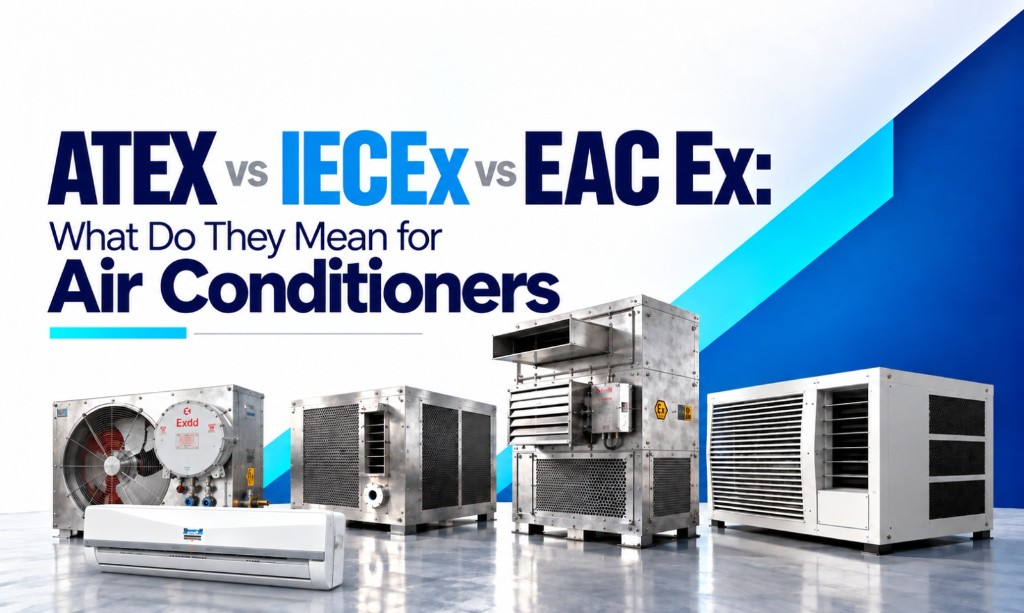
When air conditioners are installed in hazardous or classified industrial environments, choosing the right equipment is about more than cooling performance. The air conditioner must also be suitable for the specific hazardous area, operating conditions, and applicable safety requirements.
Certifications such as ATEX, IECEx, and EAC Ex help identify whether explosion-proof air conditioners and other Ex equipment have been assessed against the requirements of the relevant certification system.
For industries such as oil and gas, petrochemical, mining, marine, and other hazardous-area applications, understanding these certifications can help engineers and procurement teams select the right explosion-proof air conditioner for a project.
What Is an Explosion-Proof Air Conditioner?
An explosion-proof air conditioner is designed for use in environments where flammable gases, vapours, or combustible dust may be present.
Unlike standard air conditioners, explosion-proof air conditioners are designed with specific protection features intended to reduce the risk of ignition in hazardous environments.
Depending on the product and certification, an explosion-proof air conditioner may be suitable for applications such as:
- Oil and gas facilities
- Petrochemical plants
- Control rooms
- Driller rooms
- Electrical rooms
- Hazardous goods warehouses
- Gas stations
- Oil and gas skids
- Battery rooms
- Analytical shelters
- Marine and offshore facilities
The required certification and protection level depend on the hazardous-area classification and project requirements.
What Does ATEX Mean for Air Conditioners?
ATEX refers to the European regulatory framework for equipment intended for use in potentially explosive atmospheres.
For explosion-proof air conditioners, ATEX requirements are relevant when the equipment is intended for applicable hazardous environments within the European regulatory framework.
ATEX classification considers factors such as the type of hazardous atmosphere and the level of protection required.
When evaluating an ATEX-certified explosion-proof air conditioner, project teams should check the complete certification and equipment markings rather than relying only on the term “ATEX.”
What Does IECEx Mean for Air Conditioners?
IECEx is an international conformity-assessment system for equipment, systems, and services used in explosive atmospheres.
IECEx certification involves independent assessment through approved certification and testing bodies. Certified equipment can be listed and verified through the IECEx system.
For explosion-proof air conditioners, IECEx certification can provide an internationally recognized way of demonstrating conformity with applicable IEC standards for explosive atmospheres.
This can be particularly useful for multinational oil and gas, petrochemical, marine, and industrial projects where internationally recognized Ex certification is required.
What Does EAC Ex Mean for Air Conditioners?
EAC Ex relates to the requirements of the Eurasian Economic Union (EAEU) for equipment intended for use in explosive atmospheres.
An EAC Ex-certified explosion-proof air conditioner may be required for projects or markets where EAEU technical regulations apply.
As with ATEX and IECEx, the certification should be reviewed together with the equipment's technical documentation, markings, protection method, and applicable hazardous-area classification.
ATEX vs IECEx vs EAC Ex: Key Differences
These certification systems are not simply interchangeable. The certification required for an explosion-proof air conditioner depends on the project location, regulations, specifications, hazardous-area classification, and customer requirements.
| Certification | Main Region / Scope | Purpose | Relevance to Ex Air Conditioners |
|---|---|---|---|
| ATEX | European Union | Regulatory framework for equipment used in potentially explosive atmospheres | Demonstrates compliance with applicable EU requirements |
| IECEx | International | Conformity-assessment system based on applicable IEC standards | Provides internationally recognized Ex certification |
| EAC Ex | Eurasian Economic Union | Certification framework for equipment used in explosive atmospheres | Relevant for applicable EAEU markets and projects |
What Should You Check Before Choosing an Explosion-Proof Air Conditioner?
Certification is only one part of selecting the correct air conditioner for a hazardous area. Before purchasing an explosion-proof air conditioner, consider the following:
1. Hazardous Area Classification
Determine whether the air conditioner will be installed in Zone 1, Zone 2, Zone 21, or Zone 22, depending on the type of hazardous atmosphere.
The equipment certification must be appropriate for the intended zone.
2. Gas or Dust Classification
The hazardous substance present at the installation site also matters. Gas, vapour, and dust hazards can have different equipment requirements.
The explosion-proof air conditioner should have the appropriate protection and classification for the specific application.
3. Temperature Class
Temperature classification is important because equipment surfaces must not reach temperatures that could ignite the surrounding hazardous atmosphere.
Always check the air conditioner's certification and technical documentation for the applicable temperature class.
4. Certification and Documentation
Do not rely only on a product label or marketing description.
Check the relevant certificate, technical specifications, equipment markings, and certification details to confirm that the explosion-proof air conditioner meets the project requirements.
5. Environmental Conditions
Hazardous industrial environments can also expose air conditioners to heat, humidity, dust, corrosion, vibration, and other demanding conditions.
The air conditioner should therefore be selected based on the actual installation environment as well as the hazardous-area classification.
Where Are Explosion-Proof Air Conditioners Used?
Explosion-proof air conditioners are commonly used where reliable temperature control is required in hazardous or classified environments.
For example, control rooms and driller rooms may require continuous cooling while being located within or close to hazardous industrial areas.
Other applications can include electrical rooms, oil and gas skids, analytical shelters, hazardous goods storage areas, and other industrial facilities.
The exact air conditioner type and certification should always be selected according to the site's hazardous-area classification and project specifications.
Types of Explosion-Proof Air Conditioners
Different facilities may require different air conditioner configurations depending on space, cooling requirements, and installation conditions.
Common types include:
- Explosion-proof cabinet air conditioners
- Ex window type air conditioners
- Ex wall-mounted or split air conditioners
- Explosion-proof modular air-cooled chillers
- Ex heating and ventilation air conditioning units
The appropriate type depends on the required cooling capacity, installation environment, available space, and project requirements.
ATEX, IECEx, and EAC Ex for UAE Projects
For projects in the UAE and wider GCC region, certification requirements can vary depending on the end user, consultant, project specifications, hazardous-area classification, and applicable standards.
Oil and gas and industrial projects may specify particular Ex certification requirements for air conditioners and other equipment.
For this reason, it is important to review the project specification before selecting an explosion-proof air conditioner. The correct certification, hazardous-area classification, protection method, temperature class, and technical specifications should all be confirmed before procurement.
Explosion-Proof Air Conditioners from Power Electrical Trading LLC
Power Electrical Trading LLC supplies explosion-proof air conditioners in Abu Dhabi, UAE, for hazardous and classified industrial environments.
Our range includes:
- Ex cabinet air conditioners
- Ex window type air conditioners
- Ex wall-mounted and split air conditioners
- Explosion-proof modular air-cooled chillers
- Ex heating and ventilation air conditioning units
Depending on the product and applicable requirements, our explosion-proof air conditioners are available with ATEX and IECEx certification and are designed for applications involving Zone 1, Zone 2, Zone 21, and Zone 22 environments.
Stay Updated
Follow Power Electrical for more insights on industrial lighting and ATEX-certified solutions.
Follow on LinkedIn